Brakes and Mountain Passes
When Fred Flintstone Isn’t Enough
 A mountain pass can provide some of the most beautiful views you will ever see through an RV windshield. It can also produce the kind of white-knuckle moment that makes you promise the Lord all sorts of things if He will just get you safely to the bottom.
Before I bought a diesel pusher equipped with an engine brake, long mountain descents were among my worst RV nightmares. Going uphill may test your engine, but going downhill tests your brakes, your judgment and sometimes your nerve. Gravity never gets tired, and Fred Flintstone braking is not much help when several tons of motorhome or trailer begin gathering speed.
A recent video from Wyoming illustrated that fear all too well. A motorhome appeared to race down Teton Pass, moving around slower traffic while the driver concentrated on keeping it on the road. Thankfully, the motorhome reached the bottom without a collision and no one was injured. Authorities had not confirmed whether the RV actually suffered a mechanical or brake failure, so it would be unfair to say exactly what happened. Even so, the video offers a sobering reminder: mountain grades demand preparation and respect.
The Trouble With Riding the Brakes
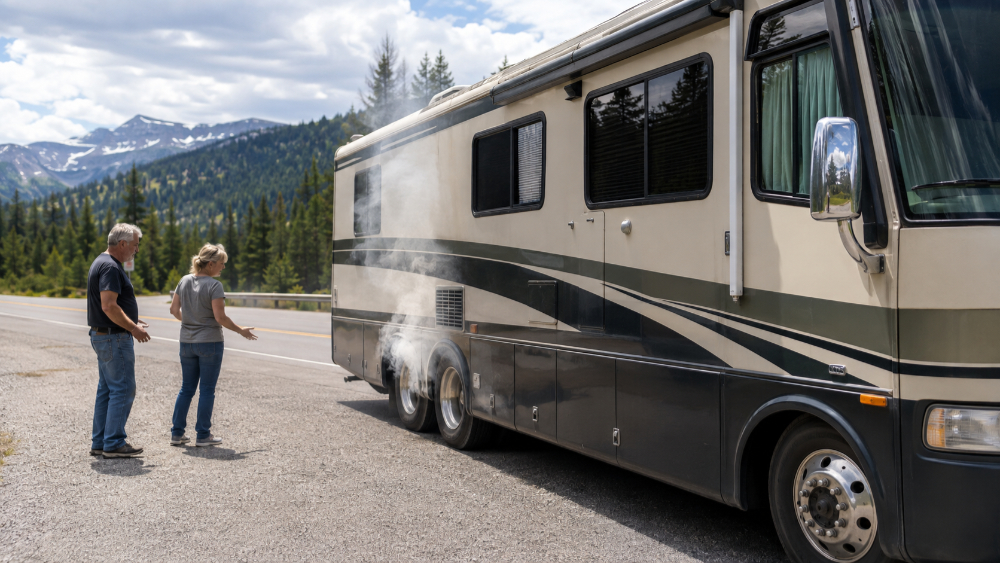
Your service brakes turn motion into heat. On level roads, that heat usually has time to dissipate between stops. On a long, steep downgrade, holding the brake pedal continuously can create heat faster than the braking system can release it.
As the brakes become hotter, they may become less effective. That is brake fade. The pedal may still be under your foot, but the stopping power you expected may no longer be there. The smell of overheated brakes is not a warning to continue more carefully. It is a warning that you may already be approaching the limits of the system.
If there is a safe place to pull completely off the roadway, stop and allow the brakes to cool. Do not touch the wheels, drums or rotors, and do not pour water on overheated brakes. Rapid cooling can damage hot components. If smoke or fire is visible, get everyone away from the vehicle and call emergency services.
The better strategy is to prevent excessive heat before it begins.
Choose Your Speed Before the Mountain Chooses It for You
The safest time to slow down is before beginning the descent. Once a heavy RV is rolling too fast, reducing speed can become much harder with every passing second.
Select a lower gear early and use the transmission to help control speed. Tow/Haul mode, when equipped, can change transmission behavior to hold lower gears longer and provide additional engine braking. A diesel motorhome may have an exhaust brake, compression brake or another type of engine-braking system. “Jake brake” is often used as a catchall term, but these systems are not all identical.
Whatever your RV or tow vehicle uses, learn how it operates before reaching the crest of a mountain. The middle of a steep descent is a terrible place to begin experimenting with dashboard switches.
An old rule says to descend a mountain in the same gear you would use to climb it. That remains a useful starting point, but it is not a substitute for knowing your vehicle, its weight and its braking equipment. Modern transmissions may choose gears differently, road conditions vary and the descent may be steeper than the climb.
The more dependable rule is simple: begin slowly, stay within the capabilities of your equipment and never let traffic behind you pressure you into descending faster than you know is safe.
Use the Brakes With Purpose
Engine braking reduces how much work the service brakes must perform, but it does not eliminate the need for them. On many descents, the driver will still need to use the service brakes periodically to keep speed within a safe range.
Rather than lightly riding the pedal for miles, use controlled applications appropriate for your vehicle to bring the speed down, then release the pedal so the brakes have an opportunity to cool while the lower gear or engine brake helps hold the rig back. Your chassis or vehicle manufacturer’s instructions should always take precedence because braking systems and recommended techniques differ.
Keep plenty of room in front of you. A large RV or a truck pulling a trailer needs considerably more space to slow down, and wet pavement can increase stopping distance dramatically. Watch well ahead for curves, slow vehicles, construction and runaway-truck ramps. If a runaway ramp becomes necessary, use it. That is precisely why it is there. A damaged RV is better than a fatal collision.
Trailer Sway: A Jesus, Take the Wheel Moment
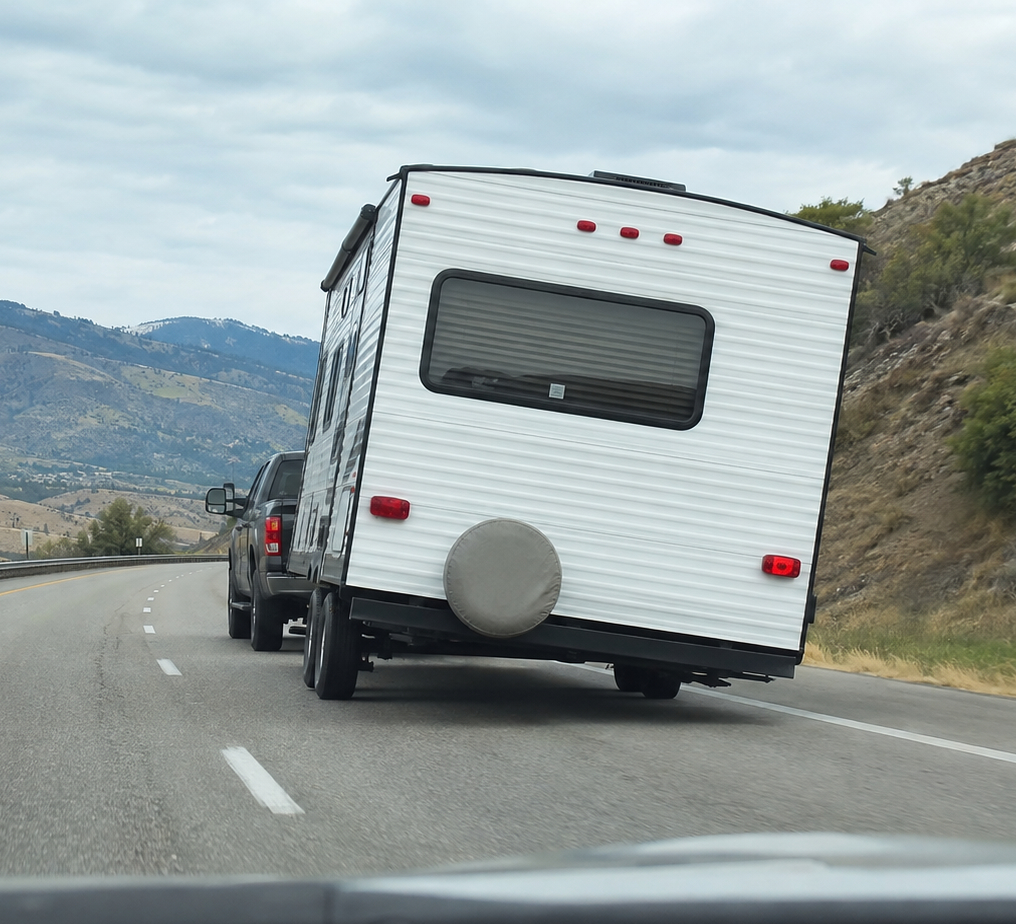
Mountain descents are not the only time gravity, speed and weight can conspire against an RVer. Anyone who has watched a travel trailer begin swinging from side to side understands how quickly an ordinary drive can become a genuine “Jesus, take the wheel” moment.
I have watched it happen directly in front of me. The truck was moving too fast, the trailer began to sway, and the driver reacted too slowly. From behind, you are watching fate unfold while trying to create enough distance that you do not become part of it. The trailer swings one way, then returns even farther in the other direction. Each correction can feed the next swing until the trailer pulls the tow vehicle across a lane, into another vehicle or off the road.
It is scary as crap for the person towing, and every bit as frightening for the drivers trapped behind it.
Sway can be triggered by excessive speed, sudden steering, crosswinds, a passing truck, improper tire pressure or a trailer that is poorly loaded. Too little tongue weight can make a bumper-pull trailer especially unstable. A weight-distribution hitch or sway-control device can help when correctly selected, adjusted and used, but no piece of equipment makes an improperly loaded trailer or excessive speed safe.
Prevention begins before leaving the campsite:
• Stay within the tow vehicle, hitch, axle and tire ratings.
• Load the trailer according to the manufacturer’s instructions, keeping cargo balanced and secured so it cannot shift.
• Verify the hitch, coupler, safety chains, breakaway cable and electrical connection.
• Check tire condition and cold inflation pressure on both the tow vehicle and trailer.
• Test the trailer brakes and brake controller before entering traffic.
• Reduce speed for wind, curves, traffic and downhill grades.
If sway begins, do not make a sudden steering correction or stab the tow vehicle’s brakes. Ease off the accelerator, keep the steering wheel as steady as conditions allow and follow the recovery procedure specified by the tow vehicle, trailer and brake-controller manufacturers. Many electric trailer brake controllers provide a manual control that may help bring a swaying travel trailer back in line, but drivers need to understand their specific system before an emergency occurs. Once the combination is stable, slow down and pull over safely to determine why the sway began.
Do not simply resume the same speed and hope it was a one-time event. Hope is not a towing system.
Before You Head Into the Mountains
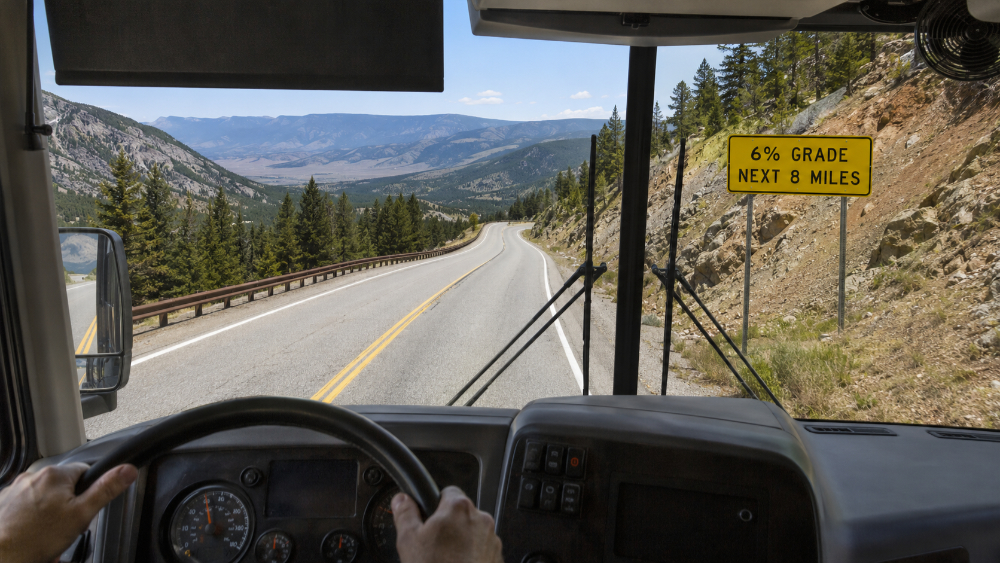
A little preparation at the campground can prevent a great deal of panic on the highway. Before taking an RV or trailer across a mountain pass:
• Study the route, including grade percentages, sharp curves, construction and restrictions.
• Know the location of steep descents and runaway-truck ramps.
• Inspect brakes, tires, fluid levels and tow connections.
• Understand your transmission, Tow/Haul mode and engine- or exhaust-brake controls.
• Confirm that the trailer brakes and controller are working properly.
• Secure the load inside the RV and trailer.
• Leave enough time that you do not feel pressured to hurry.
• If the grade, weather or equipment gives you concern, choose another route or wait for better conditions.
There is no prize for being the first RV to the bottom of the mountain.
Why This Matters for Your Trip
RV travel should be an adventure, but the adventure should come from the places you visit, not from wondering whether you can stop before the next switchback.
At Branson Shenanigans RV Park, we welcome travelers arriving from every direction, including routes through the Ozarks. The grades here may not be Teton Pass, but they can still surprise drivers who are accustomed to flatter highways. Slow down, give yourself room and arrive with enough daylight to get settled without rushing.
Whether you drive a diesel pusher, a gas motorhome or a pickup pulling a travel trailer, the fundamentals remain the same: know your equipment, manage your speed before it manages you and treat every mountain descent with respect.
Fred Flintstone may have stopped his family car with two bare feet. The rest of us need a better plan.
When your travels bring you to Branson, make Branson Shenanigans RV Park your comfortable basecamp for everything the area has to offer. We would love to welcome you.